


Feb 16-22, Free LDS Primary lesson helps, For Come Follow Me 2026, Old Testament
Updated: Feb 11

Jesus Christ will lead me by the hand.
As you and your children read Abraham 1:18 and 2:8, you could invite them to listen for a part of the body that is mentioned in both verses. Maybe you could play a game where a child closes their eyes and you lead them somewhere by the hand. Then you could talk about how it feels to have Jesus Christ lead us by the hand or protect us.
A puzzle you can put together and discuss the scripture:

I also recommend an obstacle course, as shown in this week's youth lesson. Click on the image below to visit the page.


Here is a sample of the game in the store this week.


I can be a peacemaker.
Your children might enjoy acting out the story from Genesis 13:5–12, pretending to be Abraham, Lot, and the herdsmen. How can we follow Abraham’s example of being a peacemaker with our family or friends? Try role-playing their answers.


Suggest ways they can follow Abraham’s example of being a peacemaker, such as taking turns with a toy when playing with a friend. Invite them to role-play these examples.
Put these pictures on opposite sides of the room. When you read a scenario, have the children choose the scenario by moving to the side of the room.
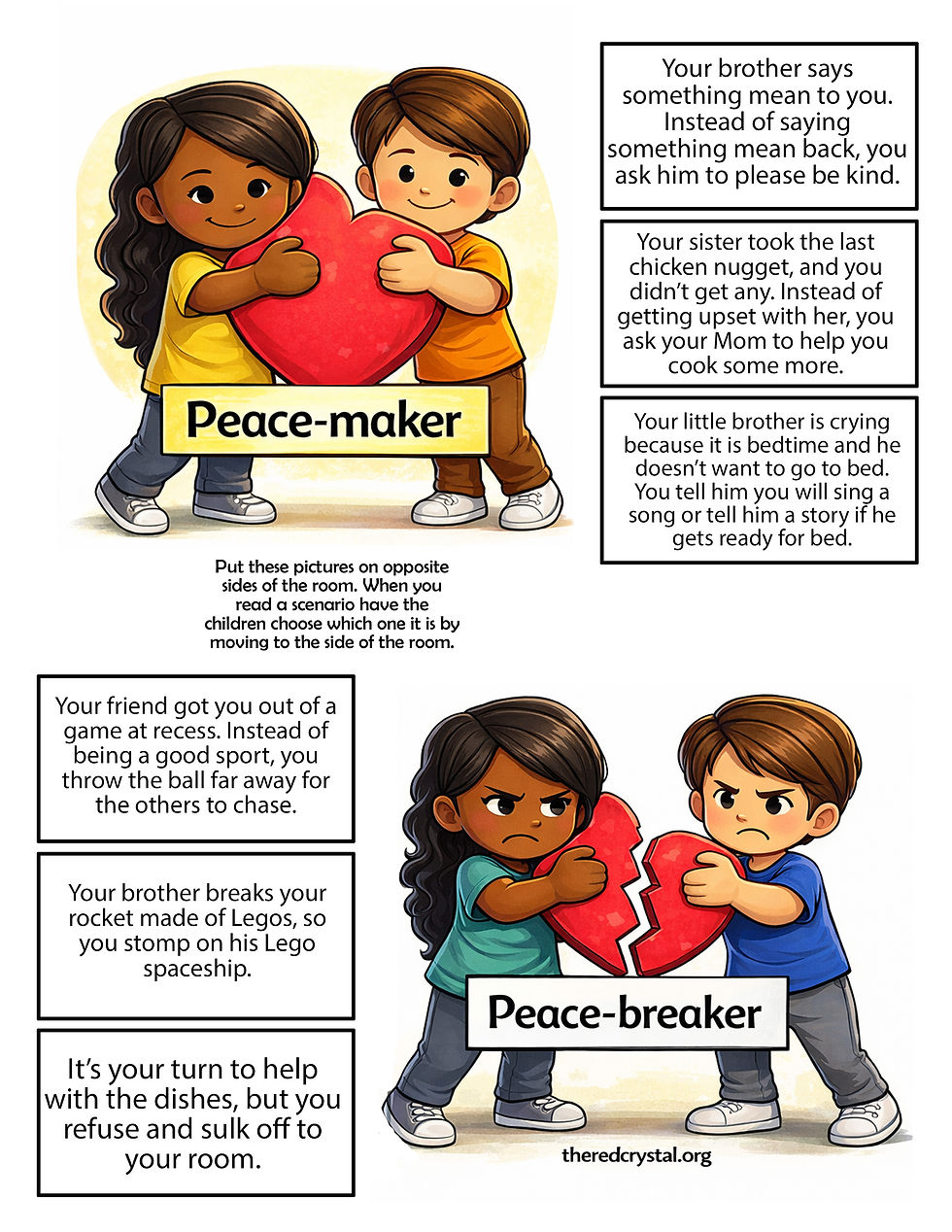

Bring two candy bars, an Almond Joy and a Kit Kat. Invite two children to the front of the class and tell them you have two candy bars. And say who wants the Almond Joy? Who wants the Kit Kat? Most likely, they will both want the Kit Kat. Sorry, Almond Joy, but kids don't like you(:
Explain how this was how the land was in the story of Abraham and Lot, and Abraham was a peacemaker and gave Lot the better land. After, cut up the Kit Kat and share it. Or bring a Kit Kat for everyone.

This is very personal, but I feel it is important to explain to children. You go by your own inspiration.

God wants me to make covenants with Him.
Consider showing your children a container of sand, the stars in the night sky, or the picture at the end of this outline. This could help them understand God’s promises in Genesis 13:16; 15:1–6. Talk about how you’ve learned to trust God’s promises, even when they seemed impossible.
To teach your children about covenants, ask them to tell you about a time when they made a promise or someone made a promise to them. If it’s helpful, share some examples of your own—including covenants you’ve made with God at baptism or in the temple. How have your covenants affected your relationship with God? Choose a few phrases from Genesis 15:1–6; 17:1–8; Abraham 2:9–11 to share some of the blessings God promised to Abraham and Sarah.
You can use this to help tell the story of Abraham and Sarah.


An idea from 4 years ago:
Invite the children to read Genesis 17:1–8 and Abraham 2:8–11 and make two lists: what Abraham was asked to do and what the Lord promised him in return. What do we learn about the Lord from these verses?

An idea from 4 years ago: Show a picture of someone getting baptized (see Gospel Art Book, nos. 103, 104). Ask the children to list the promises a person makes at baptism and the promises God makes in return. Suggest that the children look in Mosiah 18:10; Doctrine and Covenants 20:37, 77, 79 for help. What can we do to keep the covenants we made at baptism?

To help your children prepare to make a covenant with God when they are baptized, you could use some of the activity ideas suggested in appendix A or appendix B.
You can click this image to go to the page.

God hears me.
When Abraham’s life was in danger, he called on God. When Hagar was alone in the wilderness, she learned that God heard her. Consider sharing these two stories with your children: “Abraham and Sarah” and “Hagar” in Old Testament Stories, 28–31, 32–33. What do we learn about God from these stories? Then you could share with each other experiences when you felt that God heard you. A song like “A Child’s Prayer” (Children’s Songbook, 12–13) could reinforce this principle.
HAGA CLIC EN LA IMAGEN PARA VER LA LECCIÓN EN ESPAÑOL


FYI- Not sure if you are aware, but at the end of the videos linked in the lesson about Hagar and Abraham, at the end, there is 45 sec video your home being remodeled and you sitting at a desk on the computer. I thought you should know...... I noticed it last week too in the linked video from your lesson webpage.
Felicitaciones y muchas gracias por este despliegue de aprendizaje para los niños !!
The lines on the puzzle are difficult for children to cut out. Would you make the lines simpler for the children to cut the puzzle out? I usually end up using white-out to change the lines, make a copy of the page I white-out, and then use white-out on the copied page to remove the lines. Thank you. I really am enjoying your "helps".
Suggested Dialogue for a 2-3 minute Role-Play:
Abraham and Lot: The Peacemaker
Role-Play Dialogue (2-3 minutes)
Characters: Abraham, Lot, Narrator (optional)
NARRATOR (optional - can be skipped) Abraham and Lot both had become very wealthy with many animals. Their shepherds began fighting over grazing land and water...
LOT: Uncle Abraham! Uncle Abraham! We have a problem.
ABRAHAM: What's wrong, Lot?
LOT: Your shepherds and my shepherds are arguing again - shouting at each other over who gets to use the water well and the best grass for the animals. This happened yesterday too!
ABRAHAM: (sighs heavily, looking troubled) I know, nephew. I've heard the quarreling. Our herds have grown so large that there isn't enough land for both of us here.
LOT: But what can we do? We…
My kiddos love your ideas! They especially love the masks that help them act out scripture stories! In the past I have used them multiple times. Sadly, I have not saved all of them and I find myself teaching primary again, this time with a lad whose physical disabilities makes it difficult for the fine motor things, so the masks are awesome! Can you connected me with some of your past masks…maybe in your store? Also: any women?